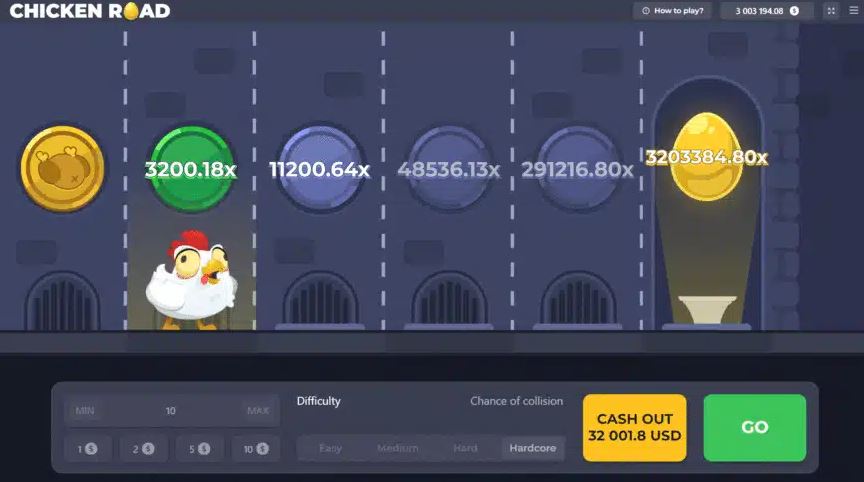
Chicken Road is the original crash game from InOut Games that established the mechanic later refined in Chicken Road 2. Released before its sequel, it introduced the format that has since become one of the recognisable templates in the crash game category — a chicken crossing a road lined with flaming ovens, with the player deciding at each step whether to keep advancing for a higher multiplier or cash out before the next obstacle risks wiping the round.
The game’s appeal has never come from complexity. It is stripped-down by design, and the tension it generates does not depend on flashy features or animated set pieces. Every square crossed pushes the multiplier one notch higher, and every additional square moves the player further from the safe cash-out point. This creates the recurring dilemma that has defined the title since launch: will the next decision be the one that locks in a modest gain, or the one that tips the whole round over?
For players familiar with Chicken Road 2, the original operates on the same conceptual foundation but with meaningful differences that show in the actual play experience. Understanding what the first version does that the sequel handles differently — and vice versa — helps clarify which one better suits a particular style of play, and why the original still holds its ground alongside the newer release.
General Information
Before diving into mechanics and strategies, a quick overview of Chicken Road’s specifications shows where the original stands compared to its sequel and what type of player it suits best.
| Specification | Detail |
|---|---|
| Game name | Chicken Road (original) |
| Developer | InOut Games |
| Category | Crash game / instant game |
| Theme | Perilous road crossing |
| Mode | Solo, against the odds |
| Risk control | Player-adjusted at each step |
| Access | Browser-based, no installation |
| Player profile | Beginners and experienced players |
| Relationship to CR2 | Predecessor, with distinct RTP profile |
What this summary hints at is the dual identity that carries through both versions: easy to pick up, but with genuine strategic room to grow. The fact that the risk level is entirely modulated by the player’s choices — rather than imposed by the game configuration — is a signature that Chicken Road established and that Chicken Road 2 preserved.
How to Play Chicken Road
Getting started with the original Chicken Road requires no preparation, but a few minutes spent understanding how a round unfolds makes the experience considerably more readable. Each round follows a distinct sequence that repeats consistently across sessions:
- Set the initial bet — decide the amount to stake before the round starts, calibrating against available balance rather than momentary impulse
- Confirm the bet and start the round — the chicken begins its crossing as soon as the round is validated
- Watch the multiplier climb — each square crossed pushes the multiplier up a step, with the current value displayed on screen in real time
- Choose when to cash out — click the cash-out button at any point during the crossing to lock in winnings at the current multiplier
- Collect the winnings — the balance is credited immediately if the cash-out precedes a failure, or lost entirely if the chicken is caught by an oven before the click
- Adjust the stake for the next round — based on the previous outcome and the overall session strategy
The strategic heart of the game plays out at step 4. Cashing out too early leaves a significant portion of the potential behind, while cashing out too late tips over the entire stake. There is no absolute right moment — only a personal compromise between appetite for risk and caution. This is the same core decision that carries through to Chicken Road 2, though the sequel’s lower RTP means the same decisions produce statistically different outcomes over time.
Chicken Road Demo
For players wanting to explore the mechanics without financial commitment, InOut Games provides a fully free demo version accessible directly through the browser without registration. This mode faithfully reproduces the paid version’s experience, with the same graphics, dynamics and — critically — the same mathematical probabilities. The 98% RTP applies to both modes.
The main advantages of the demo can be summarised as follows:
- Unlimited virtual balance — the credit reloads automatically once exhausted, allowing test sessions with no time pressure
- No registration required — the game launches directly in the browser without account creation
- Mechanics identical to the paid version — the RTP, volatility and multiplier behaviour are exactly the same
- Ideal for calibrating risk tolerance — test different cash-out thresholds (x1.5, x3, x5) at zero real cost
- Useful for experienced players — trial a new approach before applying it to a real bankroll
A quick comparison between the demo and the real-money version:
| Aspect | Demo Mode | Real Money |
|---|---|---|
| Registration | Not required | Mandatory |
| Balance | Virtual, unlimited | Real, needs deposits |
| Winnings withdrawable | No | Yes |
| RTP | 98% | 98% |
| Volatility | Medium to high | Medium to high |
| Psychological pressure | Minimal | Real |
The last row of the table is arguably the most important difference in practice. A player who cashes out easily at x2 in demo mode may find themselves hesitating at the same multiplier in real money, with tangible sums on the line. This is precisely why the demo, useful as it is as a learning tool, does not entirely replace the experience of the paid version — the pressure genuinely changes the decision-making, and no amount of demo practice fully prepares for the moment real money enters the equation.
Chicken Road vs Chicken Road 2: The Real Comparison
For players arriving here from a Chicken Road 2 context, the question underneath everything else is usually the same: is the original actually different enough to be worth trying, or is it just an older version of the same experience? The honest answer is that the two games share the same core idea but diverge in ways that matter more than the surface similarity suggests. Understanding those differences properly is the point of this section.
The Headline: RTP
The most measurable difference between the two versions is the return-to-player rate. The original Chicken Road game runs at 98% RTP, while Chicken Road 2 sits at 95.5% RTP. This is a 2.5 percentage point gap, which sounds small in the abstract but compounds meaningfully across sessions. The mathematical implications get their own section below — for now, it’s enough to note that the original is measurably more player-favourable on paper.
Neither figure is unusual by industry standards. Both fall within the range considered fair for crash games, and both are higher than typical slot RTPs, which usually sit between 94% and 96%. But if a player is choosing purely on RTP, the original wins that specific comparison outright.
Difficulty Modes and Feel
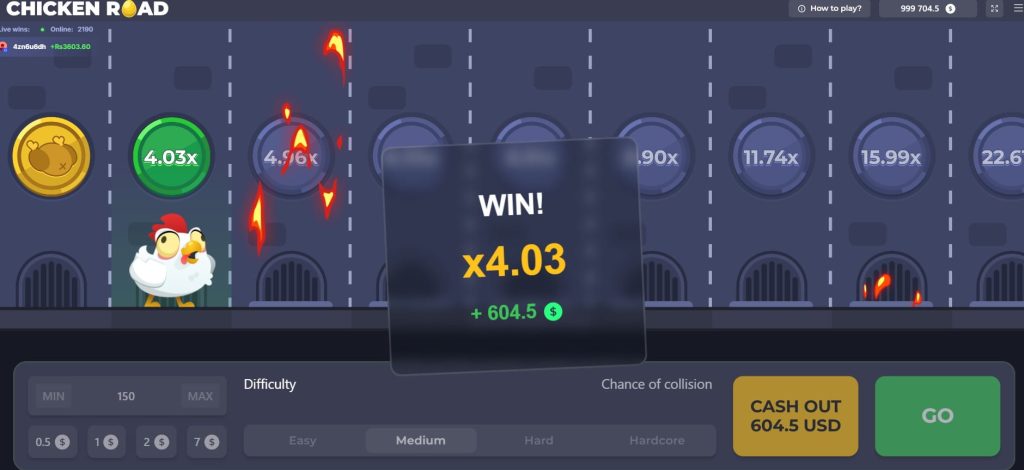
Both games use the same core structure — a chicken crossing a road, ovens as obstacles, multipliers ratcheting up with each step — but the way the difficulty levels are configured differs subtly between versions. The original offers difficulty modes that shift how many ovens appear and how quickly the multipliers escalate. Chicken Road 2 uses a similar system but with rebalanced pacing, meaning the same “medium” difficulty in one version doesn’t feel identical to the “medium” in the other.
Players who have logged serious time on both consistently report that the original feels slightly more deliberate — decisions can be made with a fraction more thinking time, and the visual pacing is calmer. Chicken Road 2 feels tighter and faster, with decisions pushed slightly more into the reflexive zone. Neither is objectively better; they suit different moods and preferences.
Max Multiplier and Volatility
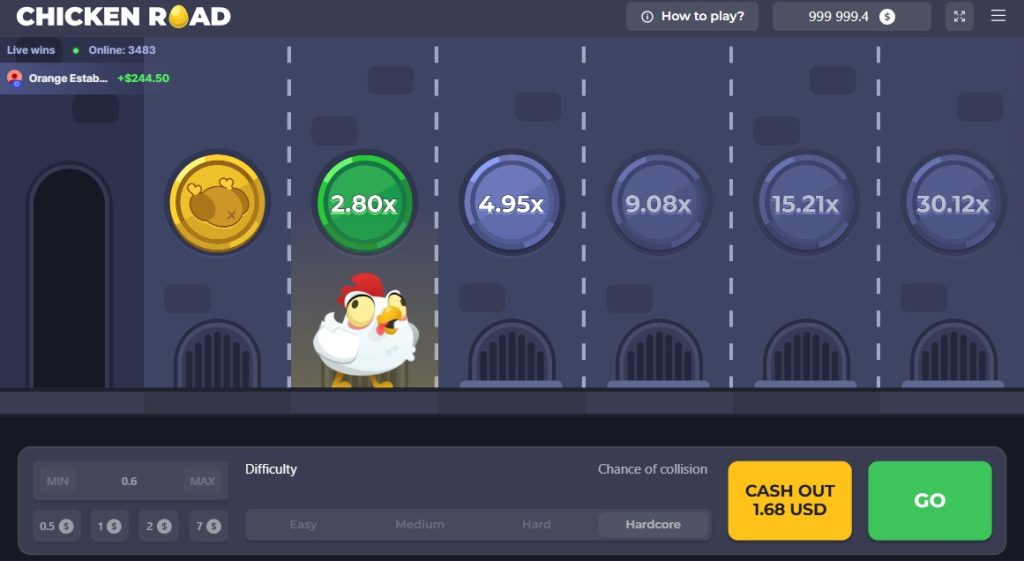
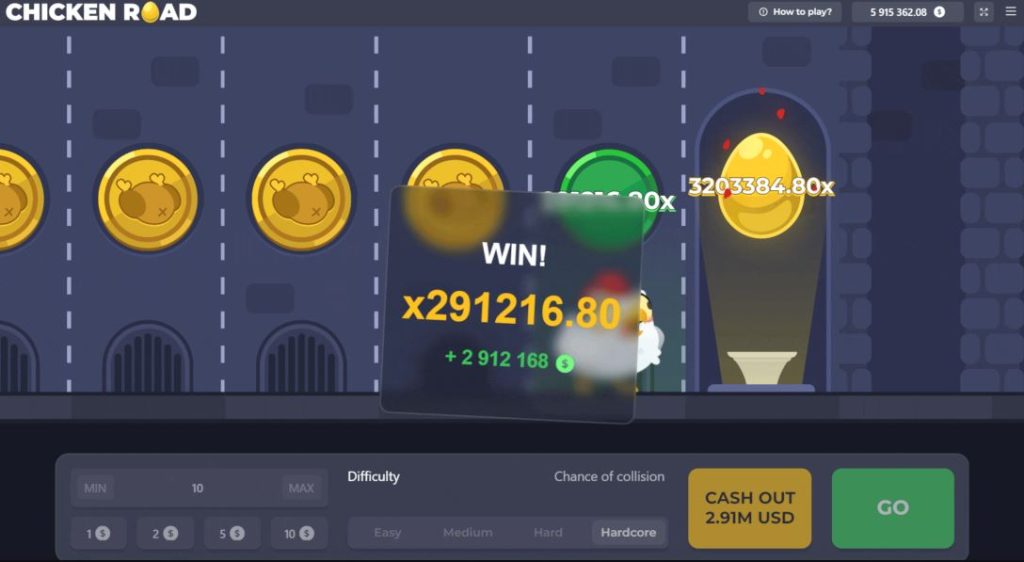
Both games advertise very high theoretical maximum multipliers. In practice, hitting anywhere close to the ceiling is astronomically rare in either version. Where the practical volatility differs is in the middle range: the original tends to produce slightly more moderate wins in the x2 to x10 range, while Chicken Road 2’s rebalanced maths pushes players slightly more toward the extremes — either quick failures or extended runs.
This is subtle enough that a casual player probably won’t notice it in a single session. Over hundreds of rounds, though, the shape of the win distribution differs measurably. Players who prefer steady moderate wins tend to prefer the original; players who like the higher-risk feel of chasing extended runs tend to lean toward Chicken Road 2.
Visual and Audio Presentation
The original Chicken Road online uses a slightly older visual style — clean and functional, but with less polish than the sequel. Chicken Road 2 upgraded the graphics, added more animation detail, and refined the sound design. Neither game is visually impressive by AAA standards, but the sequel is noticeably more contemporary.
Whether this matters depends heavily on the player. For someone who plays crash games for the decision-making rather than the aesthetics, the original’s cleaner presentation can actually be a positive — fewer distractions, more focus on the multiplier and the timing. For someone who enjoys the presentation as part of the entertainment, the sequel’s upgraded visuals genuinely add value.
The Practical Choice
For players choosing between the two versions, the decision comes down to what they actually value:
- Choose the original Chicken Road if: the 98% RTP matters, calmer pacing suits the session, or steady moderate wins are the preferred outcome shape
- Choose Chicken Road 2 if: the more refined presentation adds enjoyment, faster reflex-based play is preferred, or extended-run volatility appeals more than steady wins
- Play both if: variety keeps the experience fresh — many players rotate between them depending on mood
The two games are close enough that switching between them is essentially seamless — the muscle memory transfers directly. They’re different enough that the switch is noticeable and, for many players, refreshing.
What 98% RTP Actually Means in Practice
RTP figures get thrown around constantly in the online casino world, but very few pages explain what those numbers actually translate to when a player is sitting in front of the screen making real decisions. This section walks through the concrete implications of Chicken Road’s 98% RTP, both on its own and compared to the sequel’s 95.5%.
The Basic Math
RTP is a theoretical average calculated over an enormous number of rounds — millions or tens of millions — played collectively by all users. A 98% RTP means that for every €100 wagered across that huge sample, approximately €98 is returned to players as winnings. The remaining €2 represents the house edge, which is what the game and the casino share as their margin over time.
The critical word here is “theoretical.” RTP does not describe what happens in an individual session. A player can bet €100 across ten rounds and lose all of it. Another player can bet €100 and walk away with €500. The 98% figure only becomes reliably predictive across many thousands of rounds, and even then, individual sessions can deviate from it substantially in either direction.
Chicken Road vs Chicken Road 2 in Concrete Terms
The 2.5 percentage point gap between the original’s 98% and the sequel’s 95.5% sounds abstract, but it becomes tangible when translated into expected losses over different play volumes.
The table below shows the expected long-term loss for a €1 bet across increasing round counts:
| Rounds Played | Expected Loss at 98% RTP | Expected Loss at 95.5% RTP | Difference |
|---|---|---|---|
| 100 | €2 | €4.50 | €2.50 |
| 500 | €10 | €22.50 | €12.50 |
| 1,000 | €20 | €45 | €25 |
| 5,000 | €100 | €225 | €125 |
| 10,000 | €200 | €450 | €250 |
These are expected values, not guaranteed outcomes. Real sessions vary wildly from the average because of variance — but over sufficient volume, the actual results converge toward these figures.
What This Means for a Regular Player
For a casual player who logs maybe 100 rounds in a session and plays a few sessions a week, the RTP difference is small enough that variance dominates the outcome. Whether they end a given session up or down has almost nothing to do with the RTP and almost everything to do with how the specific rounds fell.
For a heavier player who accumulates several thousand rounds across many sessions, the RTP difference starts becoming visible in the aggregate. The player will likely still have winning sessions and losing sessions in similar proportions, but the overall balance over months of play will trend closer to the theoretical loss figures above. This is where choosing the higher-RTP game genuinely matters — not in any individual session, but in the total picture over time.
The Uncomfortable Reality
The point that most casino content sidesteps is that both games are negative-EV bets in the long run. The 98% RTP is generous by industry standards, but it still means the game keeps 2% of every bet on average. No strategy — Martingale, Paroli, Flat Bet, anything — changes this underlying mathematics. Betting patterns can distribute the losses differently across sessions, but they cannot flip a negative-EV game into positive-EV territory.
Understanding this is not meant to discourage play — plenty of players enjoy Chicken Road online purely as entertainment, treating losses as the cost of the experience rather than expecting to profit from them. But framing the game honestly is more useful than pretending a strategy can beat the house. The RTP is what it is; the choice is whether that entertainment value is worth the mathematically expected cost over time.
Who Chicken Road Is Actually For
Most casino content markets games as universally appealing, which is both dishonest and unhelpful. Chicken Road game suits some player types genuinely well and suits others poorly. This section walks through which is which, without pretending it’s for everyone.
The Player Chicken Road Actually Suits
The original game works well for players who match a specific profile. If most of the points below describe how a player approaches gambling, the game will likely deliver something satisfying:
- Short sessions over long ones — comfortable ending after 20-30 minutes rather than settling in for an evening
- Immediate decisions over slow builds — enjoys the pressure of choosing under time constraints
- Function over aesthetics — doesn’t need elaborate visuals to stay engaged
- Discrete rounds over extended progressions — prefers being able to stop after any round without leaving something unfinished
- RTP-conscious — pays attention to the mathematical structure of what they’re playing
- Can walk away without chasing losses — treats a bad session as a bad session, not a debt to recover
The Player Who Should Skip It
Chicken Road is a poor fit for a few identifiable player types. The characteristics that signal a bad match:
- Plays casino games primarily for atmosphere — will find the visual style too thin
- Enjoys elaborate bonus features — nothing here to satisfy that itch
- Wants to feel like they’re building toward something — no accumulation mechanic, no symbol collection, no progression
- Struggles with impulse control on fast games — the compressed decision cycle can be dangerous
- Prefers longer immersive sessions — the brevity will feel frustrating rather than clean
More importantly, players who struggle with impulse control on fast-decision games should be genuinely cautious. Crash games specifically compress the decision cycle down to seconds, and the next round can start immediately after the previous one ends. This is exhilarating for some players and dangerous for others. The absence of any built-in cooldown between rounds puts pacing responsibility entirely on the player.
The Player Who’s Already Playing CR2
For players arriving here from Chicken Road 2, the honest question is whether the original is worth revisiting. The answer depends on what’s been working or not working with the sequel. The table below maps common CR2 experiences to whether the original is likely to help:
| Current CR2 Experience | Should You Try the Original? |
|---|---|
| Pacing feels too aggressive | Yes — original is measurably calmer |
| Losing more than expected over time | Yes — 2.5% RTP advantage adds up |
| Happy with everything, curious about the original | Try it once, decide from there |
| Chasing losses accumulated on CR2 | No — switching games won’t fix this |
| Prefers CR2’s visual polish | Probably stick with CR2 |
| Enjoys the higher volatility feel | Stick with CR2 |
When to Just Walk Away
Worth stating plainly: if a player finds themselves needing to try both versions to chase losses accumulated on one of them, that’s the signal to stop, not the signal to switch games. Neither version of Chicken Road is a route to recovering money lost to the other. Both games take a percentage from every bet on average, and no combination of the two changes the underlying maths.
Chicken Road online works when it’s played as entertainment within a controlled budget, and it fails badly when it’s played as a solution to previous losses. Recognising the difference between those two modes of play is more useful than any strategy article could ever be.
Where to Play Chicken Road + Mobile Access
The original game is available across many online casinos and dedicated instant-game platforms. Rather than listing operators (which tend to shuffle their catalogues frequently, making any specific list quickly outdated), this section focuses on how to actually find and access the game reliably.
How to Find Chicken Road Casino
The practical way to confirm Chicken Road game is available at a specific casino is to use the casino’s own search or filter tools. The most reliable approach:

- Log into or visit the casino homepage
- Navigate to the games catalogue — usually labelled “Casino”, “Slots” or “Instant Games”
- Use the search bar and enter “Chicken Road” — not “Chicken Road 2”, since some catalogues list them separately
- Filter by provider “InOut Games” if the search doesn’t return results — sometimes indexing is imperfect
- Check the demo mode is available before committing to real money — most casinos allow demo play without deposit
If neither search nor filter returns Chicken Road, the game genuinely isn’t in that casino’s catalogue. Many casinos carry the sequel but not the original, or vice versa — the two are separate titles with separate integration contracts.
Chicken Road app and mobile compatibility
Chicken Road was built in HTML5, which means it runs directly in mobile browsers without needing a dedicated app. The practical implications for mobile access:
| Aspect | Detail |
|---|---|
| iOS support | Safari, Chrome, Firefox (iOS 14+) |
| Android support | Chrome, Samsung Internet, Firefox, Opera (Android 8+) |
| Dedicated app | None — browser only |
| Data consumption | 5-10 MB per hour |
| Orientation | Portrait and landscape both supported |
| Touch controls | Optimised for finger precision |
The mobile experience is functionally identical to desktop — same mechanics, same RTP, same demo mode. The only real difference is the smaller screen, which makes some visual details less prominent but doesn’t affect the actual decision-making that drives the game.
For players wanting an app-like experience without an actual app, both iOS and Android support adding the casino’s website to the home screen as a shortcut icon. This mimics the feel of a dedicated app while avoiding the security risks of downloading unofficial APK files that occasionally appear online claiming to be “Chicken Road apps.”
A Note on Third-Party APK Files
Any file claiming to be a downloadable Chicken Road APK is not from InOut Games and should be avoided. The genuine game is browser-based; there is no official standalone mobile app. Third-party APKs advertised as “official Chicken Road apps” typically carry security risks including malware, credential theft, or modified game logic that doesn’t match the real title’s mechanics.
Frequently Asked Questions
What is the difference between Chicken Road and Chicken Road 2?
The two versions share the same core mechanic — a chicken crossing a road with ovens as obstacles and a rising multiplier — but differ in several practical ways. The original runs at 98% RTP versus 95.5% for the sequel, giving it a mathematical advantage over time. The original also feels slightly calmer in pacing, while Chicken Road 2 uses a tighter, more reflex-oriented rhythm. Visual presentation is more refined in the sequel, while the original keeps a cleaner, more functional look.
Should I switch from Chicken Road 2 back to the original?
It depends on what’s motivating the switch. If the sequel’s pacing feels too aggressive or losses over time are adding up faster than expected, the original’s calmer feel and higher RTP will likely help. If everything is working fine with Chicken Road 2, there’s no strong reason to switch — the two games are close enough that novelty alone rarely justifies changing casinos. Switching in an attempt to recover losses from the other version is not a good idea; both games take a house edge and neither will fix the other’s losses.
Is Chicken Road's 98% RTP genuinely high?
Yes, by industry standards. Most slots sit between 94% and 96% RTP, and most crash games fall in the 95-97% range. The original Chicken Road’s 98% is genuinely at the upper end of what’s commonly available. That said, 98% RTP still means the game keeps 2% of every bet on average, so it remains a negative-EV proposition over the long term.
Can I play the game for free?
Yes. InOut Games offers a demo version with the same mechanics, same RTP and same difficulty options as the real-money version. The demo runs on a virtual balance that reloads automatically, requires no registration, and can be accessed directly through the browser. It’s a legitimate learning tool that transfers directly to the paid experience.
Does Chicken Road have bonus features like slots do?
No, and this is by design rather than an oversight. Chicken Road is a crash game, not a slot — the entire mechanic is the crossing itself and the cash-out decision. There are no free spins, no wild symbols, no bonus rounds, no jackpot triggers. The rising multiplier and the ability to cash out at any point together replace the bonus structure that classic slots use.
Does any strategy actually work on Chicken Road?
Betting strategies like Martingale, Paroli or Flat Bet can help structure sessions and manage bankroll, but none of them change the underlying maths of the game. Chicken Road has a 2% house edge whatever betting pattern is used. Strategies distribute losses differently across sessions — they don’t turn a negative-EV game into a winning proposition.
Is there a mobile app for Chicken Road?
No dedicated app exists. The game runs in HTML5 directly in the mobile browser on both iOS and Android, which is the intended and only official access method. Any downloadable “Chicken Road APK” advertised on third-party sites is unofficial and should be avoided due to security risks.
Where can I play for real money?
The original is available at many online casinos and dedicated instant-game platforms, though the specific casino catalogues change frequently. The reliable way to check availability is to search the casino’s own catalogue for “Chicken Road” or filter by the InOut Games provider tag. Some casinos carry Chicken Road 2 but not the original, and vice versa.